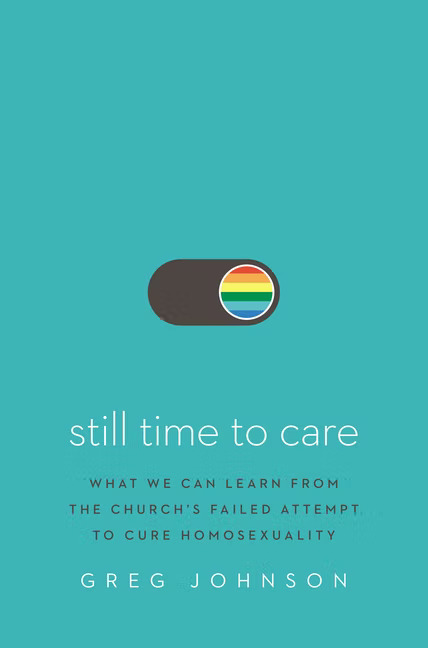
Greg Johnson. Zondervan, 2021. 245 pages.
Still Time to Care is an incredibly valuable book for readers who want to see the church care faithfully for same-sex attracted Christians. Everyone today understands that matters of sexuality and inclusion are one of the tension points between Christians and wider western society. Many of us have had friends or family members who have found themselves struggling with attractions which conflict with deeply held religious convictions. Some experience this themselves.
Sadly, the outcome for too many brothers and sisters has been their abandonment of orthodox faith or giving up on God altogether. Their stories are many and complex, often untold, but for many a major factor has been in their church’s failure to support and disciple them.
It is into this failure that Greg Johnson’s book speaks. Johnson is himself same-sex attracted (but prefers the identifier “gay”). He is also a life-long celibate, and serves as the pastor of a Presbyterian church in the conservative denomination “Presbyterian Church in America” (PCA, not to be confuses with its liberal counterpart PCUSA).
Johnson’s book was written to tell the story of evangelicalism’s shift from what he calls a paradigm of “care” for same-sex attracted believers to one of “cure”, and the failure and damage caused by the latter. This story covers the past forty or fifty years of evangelical history and is set in the context of earlier era around the mid-twentieth century. Johnson’s book also covers a range of topics that aim to uphold a traditional Christian ethic of sex and marriage, and to present a positive gospel-oriented vision of care and discipleship for churches and same-sex oriented believers.
Still Time to Care falls into four major sections.
Section one demonstrates that mid-twentieth century evangelicalism exhibited a posture of care for people with same-sex attraction, over against a more common standpoint of homophobia from wider society. Johnson shows this through some of the greatest evangelical leaders of the mid-twentieth century, including C. S. Lewis, Billy Graham, Francis Schaeffer, John Stott, and several others.




Lewis’ gentleness is revealed through letters to and from a friend named Arthur who confided in Lewis that he was gay.
Schaeffer’s care is shown in his remarkable ministry at L’Abri to young secular people (including those with a homosexual orientation); as well as in a shocking exchange with Jerry Falwell and his influence within the Presbyterian Church in America (PCA).
Graham’s ethic is seen in his firm (if faltering) conviction that the imperative to evangelism required compassion and forgiveness for those who had embraced a homosexual lifestyle.
Stott’s development of a gospel-centred response to the phenomenon of same-sex orientation took into account the theological reality of indwelling sin, eschatological hope, celibacy as a vocational calling, and the deep importance of friendship.
These were four key influencers of evangelicalism prior to the “culture war” and the “ex-gay movement” which would emerge in the 1970s. There were many more who promoted a “positive gospel vision for gay people and the church.” In their ministries, we see “a focus not on curing homosexuality but on caring for people. We see that the locus of hope lies in the coming age. The present age is a time not for cure but for care” (p. 35).
Section Two recounts in great detail the people, organizations, processes, discoveries, and failures of what was called the “Ex-gay movement.” This movement insisted that homosexual orientation could be cured if only the right techniques were used (spiritual, therapeutic, and otherwise) and if there was a desire for change on the part of the client. It believed that same-sex orientation could be cured, leaving the client happily straightened out, now identifying confidently as “ex-gay” and ready for heterosexual marriage. The previous paradigm of “care” gave way to one of “cure,” and the movement came to dominate evangelical expectations for same-sex attracted believers.
The movement collapsed due to its lack of success,[1] and left a wake of damaged and disillusioned people, although there were many others who benefited from the supportive communities and tailored discipleship programmes.
A particularly fascinating chapter (for me) was called “Postmortem.” This chapter highlighted the theological problems built into the movement, which largely sprung from Pentecostal and fundamentalist groups which had “an underdeveloped theology of sin” and “an overrealized eschatology.” Essentially, these groups expected more than God has promised us in this age and neglected to account for the persistence and effects of indwelling sin—similarly to so-called “prosperity theology.” He writes:
“The history of the ex-gay movement is a history of a movement coming to terms with a huge disappointment… [it] fostered an overrealized, triumphalistic eschatology which lined up with neither Scripture nor experience. An overrealized eschatology transfers the Christian’s hope from the coming age to the present life, placing expectations on God that he does not place on himself. The Christian Scriptures are much more measured about what we should expect during this brief lifetime” (p. 143).
Section two is the longest section of the book and at times felt long and overly-detailed, but the history of this movement is here mapped out for the first time. Undoubtedly the detailed treatment will be valued by those who have been impacted (positively or negatively) by the ministries described in these chapters.
Section Three includes three chapters restating and defending a traditional Christian ethic of sex and marriage. The first (chapter 14) gives a succinct summary of the debates over key passages—Gen 1–2, the Leviticus prohibitions, 1 Cor 6, 1 Tim 1, Rom 1), and engages with a recent proponent of an “affirming” standpoint and gives reasons for rejecting their arguments.
A second chapter explores sources on sex and sexuality from ancient Greece and Rome and argues that New Testament writers would have understood the concept of a homosexual orientation, thus undermining the argument that authors like the Apostle Paul would not have understood consensual and loving same-sex relationships such as are contended for by progressives today.
The third chapter tackles the question of whether the biblical sexual ethic is inherently dangerous to gay people, and argues that “to the degree in which it is immersed in a biblical culture of radical grace, it is not … [and] to the degree that it is removed from that biblical gospel culture, however, it becomes weaponized and cannot help but do violence to gay people” (p. 186).
Section Four articulates “A Way Forward” for same-sex attracted Christians today.
One chapter wades into the ongoing argument over what terminology is appropriate for self-identification of same-sex attracted Christians (i.e. whether “gay” should or should not be used), and engages with the remnants and after-effects of the Ex-gay movement’s philosophy of ministry.
Another chapter warns against the unintended hurt than can be caused by using terminology and categories in ways that treat same-sex sex as a special category of sin and temptation.
Chapter nineteen proposes several ways to help revive the ethic of care that characterised evangelicalism as described in section one. It particularly highlights the importance of strong community and minimizing the shame of same-sex orientation.
The final chapter of the book presents a positive vision for same-sex attracted Christians, promoting the vocation of celibacy and affirming the reality of future, eschatological hope and its implications for strugglers.
Still Time to Care is an important book for the church in the western world in the present time. It provides an analysis of what was mistaken in the efforts to cure same-sex attraction, and how poor theology has reinforced unwarranted expectations. It also points us toward proper discipleship for same-sex attracted Christians: as he puts it, it is holiness, not heterosexuality that is the goal. Johnson is not without his critics from elsewhere within the conservative Christian world (for his material in section four), but the book is very helpful on several levels and is certainly worth reading if you wish to understand the recent history of the issue and to help people today. His own personal faith in Jesus and engagement in the struggles of same-sex attraction and celibacy shines through in this book. Certain parts may raise eyebrows among conservatives, but Johnson definitely works within a theologically conservative framework and should be listened to by all Christians wishing to be biblically faithful and pastorally caring.
Still Time to Care is available from Amazon here and was priced at US$15 in November 2024 (+ GST and shipping)
[1] Johnson cites leaders of the ex-gay movement who admit that they saw no successes, although other people have seen orientation change successfully. Without wading into the argument, my own surmising is that such changes can happen, but rarely.

 Chris Northcott