
One of the earliest ministries I was part of was in the youth unit of a prison. It was only for one year, and at the time I was only 18 and had been a Christian for a little over twelve months. In many respects I was out of my depth. But it was a formative experience for me and, Lord willing, my involvement may have made some lasting impact on the young men I met.
These are some of the memories I have of that year of prison ministry, and some of the lessons I learned.
The circumstances. This was part of an informal ministry internship that I did with Scripture Union in 2004. I had just finished high school, and was planning to move to Auckland in the following year to train for ministry at the Bible College of New Zealand (now Laidlaw College). The internship involved various forms of youth ministry, mainly in schools with lunchtime Christian groups. I was interned with a Scripture Union worker named Judy, who I had met in 2003 as a year 13 student in one of these groups, and whose youngest son was good friends with one of my schoolmates.
The prison ministry happened on Friday afternoons. We would drive an hour south of Hamilton to Waikeria prison, a complex of fenced compounds scattered across South Waikato farmland. Our first check in was at the office building not far past the gate. We would drive past the main men’s prison units, past the women’s unit, the sex offenders’ unit, and the high security unit that looked a bit like an old fortress (which was demolished after being damaged during week-long riot in December 2020).
The youth unit was the last complex. We would park, request entry at the automated gate, wait for the gate to unlock, walk down the roofed corridor of chain-link fence, and check in at the front office building. Once in, the guards would unlock a door and direct us towards the large room at the end of the office building, where we would wait while the guards went to see which inmates wanted to come to our hour of Bible lessons, prayer, and pastoral counselling.
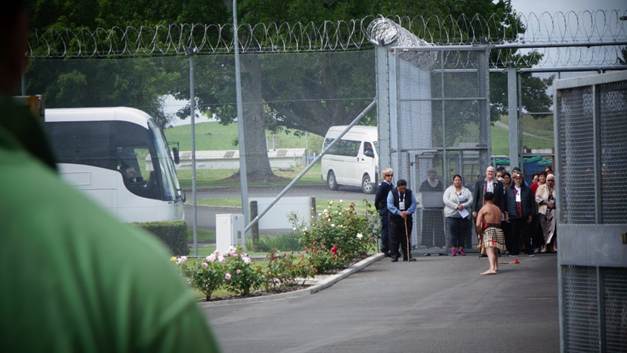
The inmates would arrive from one of several accommodation blocks across the courtyard which we only ever saw through the windows of this room. Each week, we would wait and see to find out how many boys would walk through the door from the courtyard. We would also wait and see to find out which boys would come. As time went on we got to know many of these young men, and if they were absent we would inquire of their whereabouts from the other boys. Sometimes they had been released or moved into the adult unit. Sometimes they had scheduled appointments, were on lockdown in their cell for bad behaviour, or just didn’t want to come today. Often we just didn’t know.
I was aged 18–19, from a mostly sheltered upbringing, meeting offenders aged around 17–18 who had typically had a worse start to life than I had had, and been involved in worse things than I ever had. It was a bit of a culture shock, to say the least. I had been a Christian for one year at this point, with a rather limited understanding of Christian faith and very limited pastoral experience. But I was keen to serve, and so there I was, over my head. Most of the teaching was done by Judy, but I would talk and pray with the boys later in our hour.

My first visit had probably 20 inmates, and the most we ever had at once. I hadn’t known what to expect, but this large group of young men silently sauntered in and sat down around the tables in our room while I stood next to the Scripture Union worker Judy and an elderly woman who served as the prison chaplain and who introduced us to the boys. After a short Bible study (I forget the topic) we split them into three groups to talk with them.
The memory of this first encounter that has lingered most strongly with me was that of a young man aged 18, sentenced for 18 years for murder. We never asked the inmates why they were there, but sometimes they told us. This one told me he had been in a “situation” where a group got carried away during an altercation which left someone dead. This inmate said he wasn’t the one who did the murder, but the blame got pinned on him, and the court held him responsible, and so here he was in the Waikeria prison.
He had only recently been incarcerated and seemed still to be processing what had happened to him. I don’t know what brought him to our meeting. Possibly he was grasping for hope, or looking for some way to make sense of his fate of spending more years behind bars than he could look back on in his living memory, for something he didn’t feel responsible for. We never saw him again. He was probably moved to the men’s prison not long after that.
I doubt I had much to really offer this young man, but he is my first impression of prison ministry. He was only months younger than me, and I remember at the time thinking what my life would involve for next 18 years that his would not: training, employment, marriage, children, and more. He came to my mind when I turned 36 a few years ago. By that point he would have served his sentence and be beginning adult life on the outside, hopefully experiencing what he had missed out on so far.

For my second visit I was on my own. Judy (the SU worker) had to be away that week. It was a daunting prospect, but I went. Fortunately, the elderly chaplain came along to support me (she normally did not join us on Friday afternoons). I had little idea what to do, so she suggested we sing some hymns from some hymnbooks she had brought along. As she began to warble away in antiquated tunes, the inmates and I found common identity: we all were very young and very unfamiliar with such strange old songs! They and I were awkwardly bemused at the weird singing that we were unable and unwilling to really join in with.
There was one young man I had a lot to do with over some months. His name was Tamati. The first time we met he told me that my bright red hoodie made him want to punch me—red was the colour of a rival gang. He told me that he knew I had no idea about the gang-colour issue so he wasn’t personally angry at me (I never wore that red hoodie to prison again!). Tamati was someone I enjoyed seeing each week. He readily engaged with the Bible studies and prayer, and was happy to share with me about how his life was going. Had a baby son he had never seen, whom he was looking forward to meeting upon his upcoming release. He was adamant that he wanted to make better choices when he was released so that his son would grow up doing better than he had done.
After some months Tamati was released, and he left me the cell phone number he would have once he was out. We kept up some irregular conversations via text message for about a year until one day he didn’t reply. A week or so later his mother replied via his phone to explain he was back behind bars. I didn’t ask for details, but I hoped and prayed that it wouldn’t be for long and that he could fulfil his wish for his son.
The Iranian. This inmate came for some weeks and was a Muslim. His English was limited, and he told us he had learned to speak English from watching TV. He couldn’t read in English, and so I managed to acquire a New Testament in Arabic through a former missionary at my church. He was grateful for this gift and avidly flicked through it, scanning through pages. Possibly he had read nothing in his own language for a long time, and was intrigued by possessing the Christian Scriptures in his own language.
Unfortunately, we never saw him again. The arrival of a Bible in a strange-looking language was exciting news to the other boys, and word of this soon got around the prison. The boys explained to us that there was one other Muslim inmate. This one was very serious about his Muslim faith, and regularly prayed on a prayer mat in his cell. Apparently, he had had a stern word with our Iranian friend, dissuading him from returning to our group. We prayed that he might have the courage to keep and read his New Testament.

The young dad. Another inmate with a child on the outside came regularly to meet us. Like Tamati, he wanted to be a better person so he could be a role model to his son or daughter when he was released. He came to our Bible lesson not so much because he was interested in God, but because he felt it would teach him how to be a good father for his child. This inmate was also looking forward to being moved up into the men’s prison. The adult units had a tougher, harsher culture, and he wanted to be moved there for a shock to his system that would straighten him out before he was released. But his eighteenth birthday came and went, and his expected transfer did not come. He was frustrated at this, but we were grateful to still be seeing him each week. Eventually he was moved. We suspected the prison authorities had thought it a good thing to extend his stay in the youth unit.
The Satanist. This inmate was a regular guest. He was polite and affable in his own roguish way, but utterly derisive of Jesus and of God. He claimed to worship Satan, and was doing time for sexual assault. I’m not sure why he came, although I suspect it was for his own entertainment. We learned to push back at him to keep him on his toes, and Judy’s sparring with him during the Bible study kept up plenty of interest from the other boys.
The transgender inmate. This was another regular guest at the same time. He was open and inquisitive. We firmly and gently challenged him on his gender identity when he raised it, and he was willing to hear us out.[1] He seemed to be accepted as he was by the other inmates (during our hour, at least). But he was regularly mocked and taunted by the Satanist.
One day it was pointed out to the Satanist that Satan likes to twist and wreck God’s good order, and would like him to experience the same confusion as the transgender inmate whom he so regularly derided. This was a step too far for the Satanist. He leapt from his seat, swore at us, and then paced up and down one side of the room cursing under his breath. He banged on the door to the guards’ office and demanded to go back to his cell. He had been a regular and engaged attendee for many weeks, but this was the last time we saw him. The transgender guy was very attracted to the prospect of a God who loved him despite him, but internally conflicted about how his gender identity fitted with that. I don’t know where he eventually landed.[2]
Another inmate was in for six months on a drink driving charge. He came along a few times to our Bible study and prayer time out of curiosity. I bumped into him 2–3 years later when he was out of prison, and I was back in Hamilton working a summer labouring job on a construction site. He had since learned a trade. We said hello, but had little to say to each other in these changed circumstances. I wasn’t sure what to talk about, and he might have been embarrassed about how we knew each other. We returned to our respective jobs on the work site.
One memory sticks in my mind because of its contrast. It was late in the year. On Fridays before we drove to the prison we ran a lunchtime Bible study at my old school, Hamilton Boys High. One particular Friday lunchtime the boys at the school were especially rowdy and out-of-control. One boy, sitting at the front of the class, saw fit to regularly turn around and joke with boys further back, even throwing his lunch at someone at one point. Many of them were willing to be in the classroom we used but didn’t care too much for why they had gathered. They were ruining the time for others who were eager to discover and learn about God and the gospel. They took the things of God for granted, forgetting what impact God had made on their own lives, and oblivious of what God was still doing in the lives of their fellow students. Ezekiel 34:18–19 seemed an apt verse to describe this.
How different was the prison group that same Friday afternoon. The atmosphere was completely unlike what we had just seen in the school group. It was a time when the Spirit of God rested heavily on the occasion. Unlike the high school boys, the prison boys were attentive and serious. They knew the stakes in life were too high for levity when they were being taught God’s Word. The offer made to them in Jesus and the way of life he commanded was something to be taken seriously. The gospel’s requirements of faith and repentance and obedience were matters they listened to carefully and that stuck with them as they left our room to go back to their cells. It was an afternoon where the contrast between these two groups was much more marked than it normally was. It was an afternoon I have not forgotten.
I don’t remember my last visit at the end of 2004. The end of that year was a blur. Between my youthful enthusiasm for beginning Bible College studies in 2005, absorption with a troubled teenager I knew who required a lot of time and care, and some significant family challenges in the last months of that year, I have no idea how my year of weekly prison ministry ended. I don’t know if I did much good for these boys or for God, or if it lasted, but the time spent at Waikeria has always stuck with me. I wish I could remember more of their names.
Apart from the memories of particular boys, there are a few lessons for ministry I took away with me:
- Prison ministry is transient. Relationships cannot be built in the same way as most ministries. The controlled environment of a prison limits this. We couldn’t see or communicate with the boys outside the hour once a week, and then they couldn’t always turn up. Sometimes they had been moved on. Sometimes internal (gang-related?) tensions prevented some boys from coming at all. Contact with the boys after their sentences were ended was not normal (I’m not sure if passing on phone numbers was allowed). Because of all this, it is important to make every time count.
- Prison ministry is an opportunity to bless non-church people with a listening ear and the offer of the gospel. Christians should be more willing to step out into ministries that put them in contact with non-church people, who have different expectations and understandings. It can be awkward and challenging and sometimes feel futile, but we should be more ready to enter into ministries outside of the church: schools, universities, hospitals, rest homes … and prisons. Be willing to step into new places in the name of Jesus, to offer yourself and the blessings of the gospel.
- Train to be able to “wing it”—this was something Judy taught me was important. We never knew who was going to come through those doors each Friday, or what they might bring with them. We just had to be ready to respond with grace and wisdom and the Word of God. It is better to know the Bible and Christian doctrine well enough to draw on it as needed for the situation, and not be too tied to a lesson plan that turns out to be unsuited for the occasion. Learn Scripture well and be ready for anything.
- Sin and guilt weren’t contested concepts in prison. Everyone there knew they had done something wrong. Whether they accepted any personal accountability for it, or saw need for forgiveness with God, was another matter. People humbled by life experiences are more open to hearing the gospel.
- Think about the spiritual needs and learning needs of those your meet, and aim to meet them where they are at. The Arabic New Testament was one such example that made a real difference, even if lasting fruit is uncertain. Be responsive and resourceful.
- Remember those in prison. The last I will share comes from a verse that Tamati came across one day in his cell. In his Good News Bible, he found Psalm 69:33 – “The LORD listens to those in need, and does not forget his people in prison.” He was deeply impacted and encouraged by the fact that God had not forgotten or ignored him because he was in prison. Many of the inmates felt discarded and forgotten while they spend months and years behind bars while everyone else’s lives moved on. But God does not forget his people in prison—will you?
[1] This was a less fraught issue twenty years ago.
[2] Fortunately, there are many helpful resources for care and counselling for people with gender dysphoria that were not available two decades ago. For anyone wanting to explore this subject further in a way that is both pastorally gentle as well as faithful to Christian values and worldview, there are two books worth checking out:
- Emerging Gender Identities: Understanding the Diverse Experiences of Today’s Youth, by Mark Yarhouse and Julia Sadusky (2020). Available from Amazon.
- Embodied: Transgender Identities, the Church, and What the Bible Has to Say, by Preston Sprinkle (2021). Available from Amazon.

 Chris Northcott